


Cártama, the ancient Guadalhorce town worth visiting before reaching the Costa del Sol
Just a few kilometres from Málaga and the province’s beaches, Cártama preserves archaeological remains, an old fortress, a historic chapel and an agricultural landscape shaped by centuries of history.
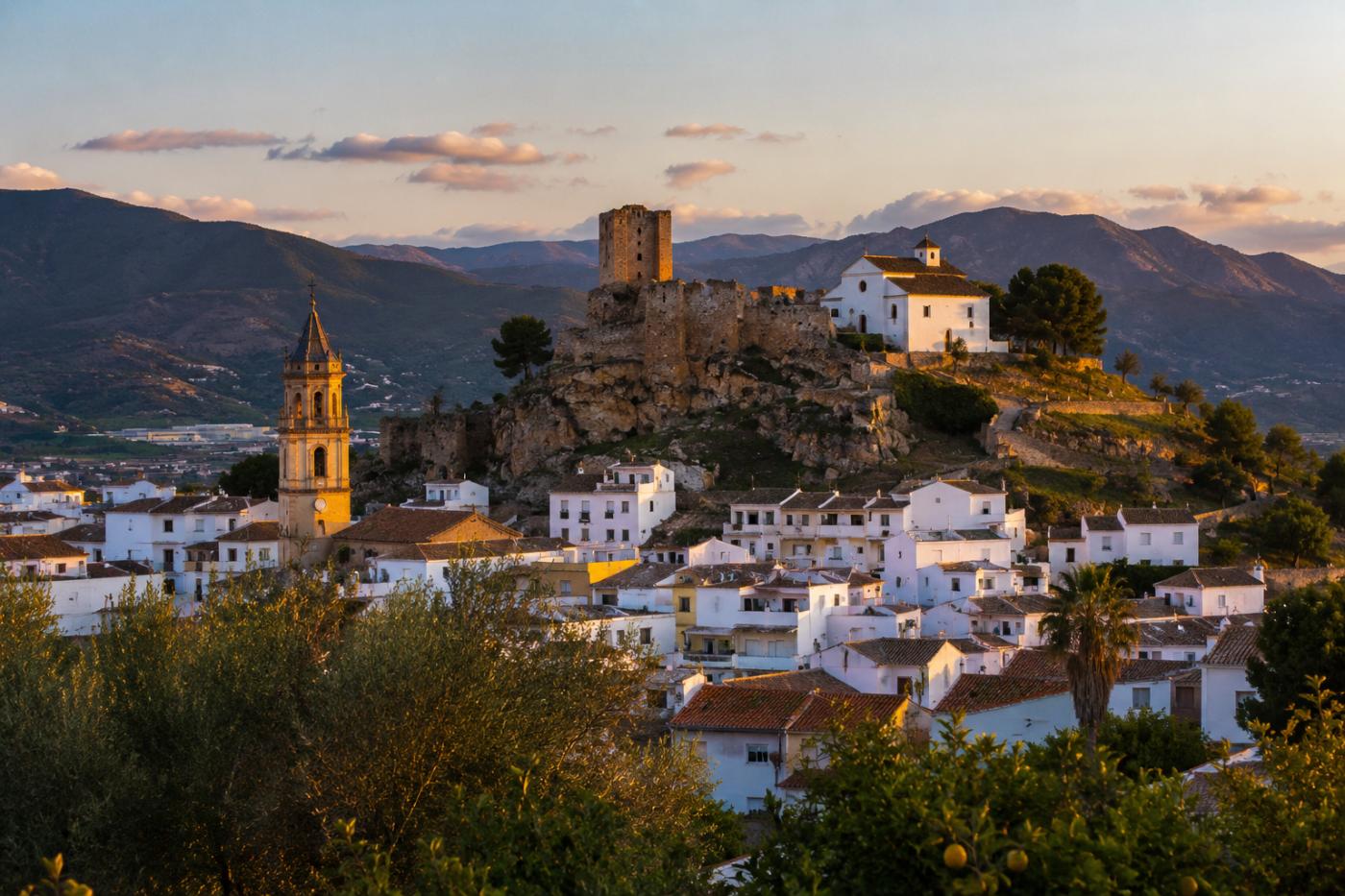

Many travellers cross the Guadalhorce Valley with their sights set on the beaches of the Costa del Sol. From the road, Cártama appears as a cluster of whitewashed houses stretching across the hillside, a view that is often left behind within minutes. Yet stopping here reveals one of the most historically significant towns in inland Málaga.
Its strategic position between the provincial capital, the inland territories and the routes leading to the coast made it an important centre for travel, trade and defence. Today, that heritage can still be seen in its archaeological remains, the ruins of its castle, the silhouette of the Chapel of Nuestra Señora de los Remedios and the fertile countryside shaped by the Guadalhorce River.
A settlement inhabited since ancient times
Cártama’s history dates back to the earliest communities established in this area. The Phoenicians called the settlement Cartha, a name associated with the idea of a hidden place, while during the Roman period it became known as Cartima.
The Roman town achieved considerable importance within what is now Málaga province. Its location on a hill overlooking much of the valley made it possible to control commercial routes and the fertile farmland surrounding the settlement.
The discovery of mosaics, sculptures and remains of ancient buildings reflects the importance the town once held. Visigothic and Muslim communities later left their own mark, adding further layers to a history spanning more than two thousand years.
The castle that watched over the Guadalhorce Valley
At the highest point of the town stand the remains of Cártama Castle, a fortress that became particularly important during the Andalusian period. Its position provided control over the roads, cultivated land and movement throughout the valley.
Although only sections of walls and defensive structures remain today, the site still offers an impression of its former strategic significance. Rather than a fully restored fortress, it is a place where the ruins blend naturally into the surrounding landscape.
From the castle area, visitors can enjoy sweeping views of Cártama, the Guadalhorce plain and the mountains surrounding the municipality. The climb follows steep streets, but the panorama offers a privileged perspective on the relationship between the town and its territory.
The Chapel of Nuestra Señora de los Remedios
Close to the old fortress stands the Chapel of Nuestra Señora de los Remedios, one of Cártama’s main religious and architectural landmarks. Located on Monte de la Virgen, it overlooks the town from above.
The building combines a simple façade inspired by traditional Andalusian architecture with a Baroque-style interior. The chapel is deeply connected to local identity and devotion to the Virgen de los Remedios, who plays a central role in several celebrations, pilgrimages and processions throughout the year.
Beyond its religious significance, the site is also one of the finest viewpoints over the Guadalhorce Valley. From here, visitors can see farmland, urban development and the different mountain ranges surrounding the area.
Two districts with distinct personalities
The municipality has an unusual layout centred around its two main population areas. Cártama Pueblo preserves the more traditional character, with sloping streets, whitewashed houses, small squares and corners shaped by its historical past.
By contrast, Estación de Cártama reflects a more contemporary side of the municipality. Its development is closely linked to the railway, transport connections and its proximity to Málaga city. This area contains much of the town’s commercial activity and services, while also showing the growth experienced across the wider metropolitan area.
Although both districts form part of the same municipality, they offer different experiences. One invites visitors to explore the past through steep streets and historic landmarks, while the other reflects the energy of a town increasingly connected to Málaga and the rest of the province.
A landscape shaped by agriculture
Cártama’s landscape cannot be understood without the fertile lands of the Guadalhorce Valley. For generations, agriculture has played an essential role in the local economy and everyday life.
Orchards, citrus groves, almond trees, olive trees and irrigated crops form part of a region known for its agricultural productivity. Although urban expansion has transformed certain areas, farming continues to define much of the municipality and maintains the strong link between Cártama and the valley.
This environment offers visitors another side of Málaga, far removed from large tourist resorts and closely connected to local produce, family-run farms and the natural rhythm of the seasons.
A place to explore without rushing
Cártama does not need to compete with seaside promenades or the major attractions of the coast. Its appeal lies precisely in its understated character and the opportunity to discover it at a slower pace.
A visit can begin in the old town, continue along the streets climbing towards the castle and finish at the Chapel of Nuestra Señora de los Remedios. From there, visitors gain a complete view of the municipality and can understand why this location was so important to the different civilisations that settled in southern Spain.
Cártama brings together Phoenician and Roman heritage, Andalusian defensive architecture, popular devotion, agriculture and modern development. These are more than enough reasons to stop seeing it only from the road and make it part of the journey before continuing towards the Costa del Sol.
Information source: La Noción, with historical and tourism information cross-checked against the official Andalusia tourism portal.

Latest news





Upcoming events
12
Nov
El Desembarco, la traición de Viriato at La Caja Blanca
12
Nov
HOMER El Mero Mero at Sala Trinchera Málaga
13
Nov
Marbella Startup Lab – Innovate & Collaborate
13
Nov
Candlelight: Coldplay & Imagine Dragons at Sala Fundación Unicaja María Cristina
13
Nov
Candlelight: Tribute to Ludovico Einaudi at Anantara Villa Padierna
