The Thyssen Invokes Manuel Franquelo, the Malaga-born Da Vinci

12/06/2026 Updated at 16:40h.
When his son was three years old, he built him an electric motorcycle at a time when no child yet knew what that was. He also created a cable car that traveled the entire hallway and living room of the house where his Ninja Turtles 'flew'. At the same time, he would lock himself in his room to research engraving and photography processes and draw pictures of hypnotic realism. The Carmen Thyssen Museum pays tribute to Manuel Franquelo from Malaga, a "contemporary Renaissance man" - in the words of its director, Lourdes Moreno - who painted the "insignificant" and built innovative gadgets.
National Engraving Award winner in 1998, Manuel Franquelo (Málaga, 1953 - Madrid, 2024) spent his life moving between science and art. One of his greatest engineering achievements was the Lucida 3D scanner he designed along with the Factum Arte team. It has been used to scan for study and preservation everything from tombs in the Valley of the Kings in Egypt to Goya's black paintings in the Prado with great precision. And in parallel, he painted, photographed, and printed works that place him today as one of the great names in Spanish realistic art of recent years.
He created a 3D scanner that has been applied to tombs in the Valley of the Kings and to paintings by great masters.
In the exhibition 'The Language of Things', which can be seen until October 12 at the Espacio Artesonado, there are examples of all his artistic facets. Here are 14 engravings from the portfolio with the same title that earned him the National Award. "Delicate still lifes, suggestive and methodical to the point of wanting to represent the dust that settles on the shelves," points out Moreno. They are made using photo etching and drypoint from photographs taken by Franquelo himself which were digitized, manipulated, and transferred to copper plates using resin powder etching. Additionally, the artist directly intervened on the plates with abrasive techniques and drypoint. "He was absolutely in love and possessed by the very process of creation, the process that led him to produce that feeling of absolute reality in his works, and not the final part, which is what we all later contemplate," explains the director.
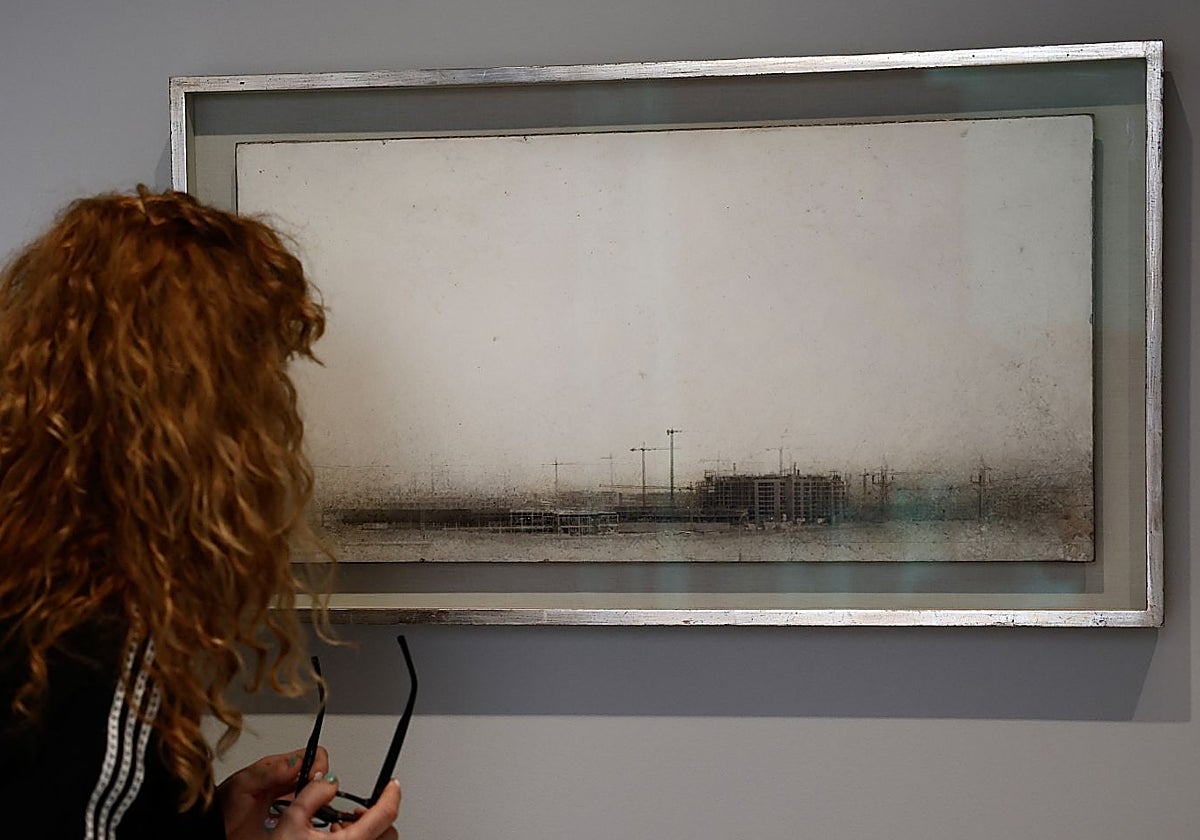
Of a restless and curious nature, Franquelo researched at the borders of production "transgressing the rules" to make the human eye fall into deception through a kind of trompe l'oeil. The engravings from that portfolio seem like snapshots, but he also took photos that looked like engravings, like the two photographic prints on display in Malaga. And, in the same way, he drew landscapes that mimicked real reproductions captured with a camera. This occurs in the drawing of a growing area of Madrid, in the Ensanche de Vallecas, where he recreates buildings under construction with their cranes and huts. And also in 'In my world I have no pain', an impressive drawing with pencil and wash on board that reproduces an aerial view of Madrid with extreme attention to detail, a piece lent by the Museum of Contemporary Art of Madrid.
He rarely titled his works, so this case is an exception. A rarity that gives rise to a reflection by his son Manuel. He says that this phrase comes from an Armenian poet of the 18th century who talks about how psychological pain can be transformed into a text, a musical composition, or a drawing. "My father's work consisted of investigating this transfiguration through works in which he sublimated his pain into the everyday objects that accompanied him throughout his life (...) It is a concession for the objects to speak, dissolving their own existence in them," he maintains. In his world, he feels no pain "because the pain has been transfigured into objects that pile up to tell their own existence". A pill, a tape, a reel, a motor, some batteries... "And this is the beautiful thing, perhaps my father's work consisted precisely in that, in giving all his time to things so that they can speak their own language," he summarized.
His widow Elena Giner claimed the man behind the artist, "a truly extraordinary being". "A master at giving encouragement, even though he often got discouraged himself," she says. His introverted nature kept him away from artistic circles and he created outside the market. "The truth is that he belonged to no group. His work was developed in solitude," his widow points out. He was represented by the Marlborough Gallery and was highly demanded by private collectors. He felt recognized, but Elena Giner admits that he longed to be more present in institutions and museums.
'The Language of Things' will be his first solo exhibition in Malaga, the city he left at just 19 years old to first study Engineering and then Fine Arts. "My father told us, with some sadness, that the city of Malaga did not love him. Today I would like to think that we are loving him through this affectionate and important gesture," said his son. An old childhood friend who attended the presentation nuanced those words: "It's not that Malaga doesn't love him, it's that it still doesn't know him."
- More topics
- Museo Carmen Thyssen

Latest news

Upcoming events
17
Sep
La Pequeña Cuba Gastro-Cultural Festival in San Pedro Alcántara 2026
18
Sep
World Wellness Weekend Marbella 2026
18
Sep
Candlelight: Queen vs. ABBA in Málaga
18
Sep
Candlelight: Coldplay and Imagine Dragons in Málaga
18
Sep
3 de Corazones – Pancho Céspedes, Enrique Ramil and José Luis Jaén in Málaga
Similar News

Málaga Airport Makes History with More Than Three Million Passengers in One Month
Málaga
Port of Málaga looks beyond its docks to support future growth
Málaga
Guide to the Virgen del Carmen Processions in Málaga and the Province
Málaga