Much More Than Bugs: The Insects That Can Help Save Soliva Lagoon
Through free guided tours, while conducting a species census, citizens are introduced to the surprising diversity of this little-known enclave in the city of Málaga.
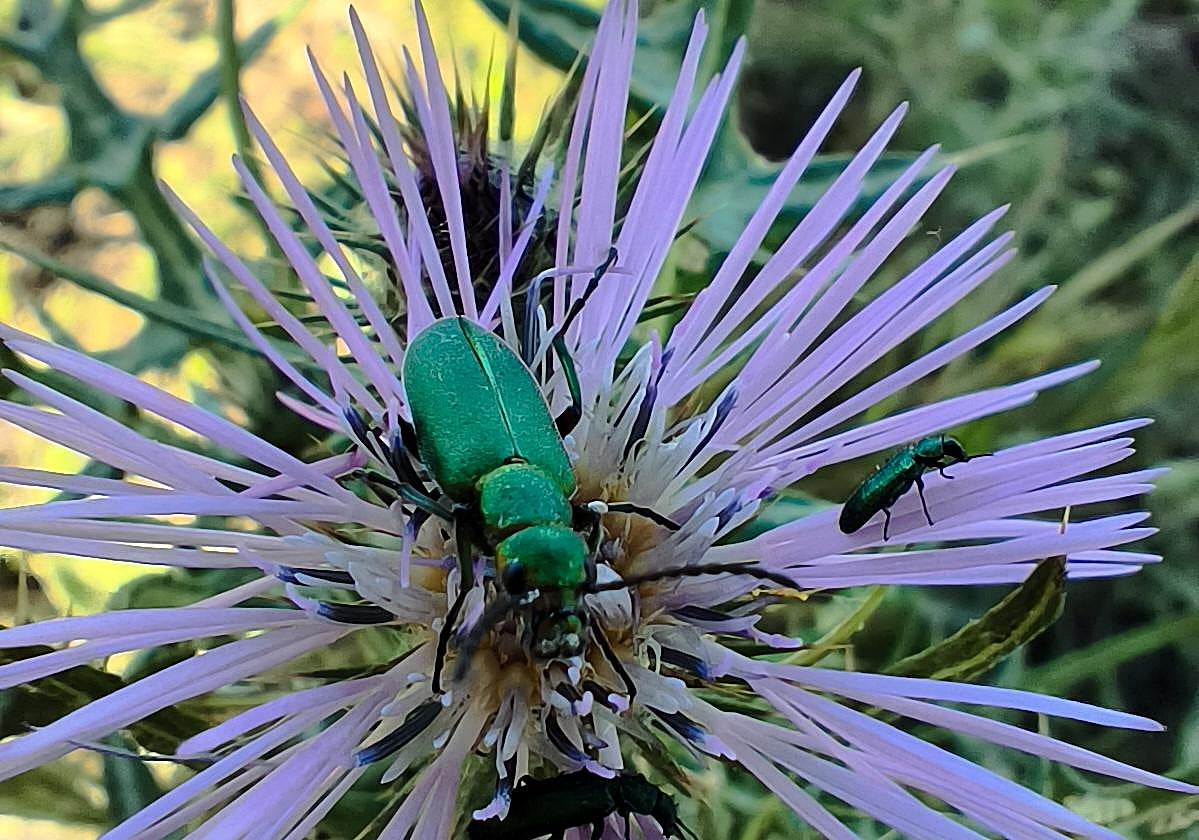

The surprise rests harmlessly in a hand. A non-attacking praying mantis, a shiny beetle that seems from another world, or tiny species that go unnoticed until someone knows where to look. Pablo and Adriana, both eight years old, watch with a mix of awe and caution what were, until recently, simply "bugs." Now they understand they are much more. Much more.
The scene repeats itself at the Soliva lagoon in Málaga, where the Andalusian Society of Entomology has launched a series of walks to bring the public closer to an almost invisible universe. Its president, José Manuel Moreno Benítez, starts the activity with a simple but revealing gesture: an entomological net that glides over the vegetation in gentle sweeps. From this seemingly random movement, insects emerge that would otherwise go completely unnoticed.
Each capture becomes a small lesson. The specimens are observed, explained, and, except in specific cases where more detailed analysis is necessary, are immediately released. The goal is not to collect, but to census and, of course, to understand. And, above all, to dismantle prejudices. "Does this sting?" attendees frequently ask. The answer opens the door to a change in perspective: most insects are harmless and essential. As for stinging, it's mostly mosquitoes and not much else. Wasps and bees actually use their stinger to defend themselves.
These entomological walks, which started in February in Soliva and are planned throughout this year, are free, do not require prior registration, are open to all audiences, and are announced in advance on social media. They attract everyone from university students to local residents or people involved in defending this space, which faces an urban threat—it is planned to be drained and the land used to build a road. All participants share a growing interest in a place that, at first glance, might look like just another wasteland, but which hides extraordinary biological richness.
The Soliva lagoon stands out not only for its water body. As José Manuel explains, the real value is also in its immediate surroundings: olive groves, grasslands, and vegetation that, after two favorable hydrological years, "has experienced significant development." This botanical diversity is the basis for "an explosion of life." So much so that, according to initial samplings, this enclave harbors more variety of insects than some mountain areas that are seemingly better preserved and protected. This is affirmed by the president of the Andalusian Society of Entomology, an authority in the field, who has numerous publications on insects. This abundance and variety in this wetland could even help save the lagoon from an uncertain future.
So far, over a hundred species have been identified, although the actual figure could be much higher. Not all insects can be recognized at a glance, and many require more detailed analysis. Still, the campaign aims to complete as comprehensive a census as possible by the end of the year.
Among the most striking specimens is the so-called 'curita payoyo,' an endemic beetle of the Betic ranges found only in areas of Málaga, Cádiz, and Granada. Its name, wrapped in various popular theories, refers both to its dark color—which resembles a cassock—and to ancient healing uses for animals. Alongside it, species with bright metallic tones or unique shapes like the 'lagorina sericea,' which surprise Pablo, Adriana, and many who observe them closely on this walk. After capturing a specimen for observation, José Manuel returns it to the field, but the insect stays perched on a flower, as if wanting to be better photographed in a more natural setting.
But beyond curiosity, the message is clear: insects are key pieces in the balance of the ecosystem. Their presence attracts insectivorous birds that, throughout the year, help control populations of flies and mosquitoes. Protecting them ultimately means improving the health of the environment and the quality of life for those who live in it.
Thus, one of the goals of these walks is to identify particularly relevant species that can serve as a scientific argument to reinforce the protection of the lagoon. It's not just about spreading knowledge, but about generating useful knowledge.
This line of work extends to other projects promoted by the Andalusian Society of Entomology. In the Sierra Mijas-Alpujata, for example, similar campaigns are being carried out to update previous studies and provide new data for initiatives that call for its declaration as a natural park. They also collaborate with the Benalmádena Butterfly Park in monitoring the endangered species 'Velludita parda bética,' which can be found in the area of Villanueva del Rosario. This is part of the Violetae 25-28 Plan, which this June will reach its first year of work.
Meanwhile, in Soliva, the best proof of the success of these walks is in the gestures of those who participate. In the gaze of those who discover that what they feared or ignored is, in reality, an indispensable piece of a much larger mechanism. And in the certainty that sometimes, saving a place starts by learning to look at what moves at ground level. As a popular saying goes, you only defend what you love and you only love what you know.

Latest news


Upcoming events
17
Sep
La Pequeña Cuba Gastro-Cultural Festival in San Pedro Alcántara 2026
18
Sep
World Wellness Weekend Marbella 2026
18
Sep
Candlelight: Queen vs. ABBA in Málaga
18
Sep
Candlelight: Coldplay and Imagine Dragons in Málaga
18
Sep
3 de Corazones – Pancho Céspedes, Enrique Ramil and José Luis Jaén in Málaga
Similar News

Málaga Airport Makes History with More Than Three Million Passengers in One Month
Málaga

Port of Málaga looks beyond its docks to support future growth
Málaga

Guide to the Virgen del Carmen Processions in Málaga and the Province
Málaga