The most curious Easter Sunday traditions in Málaga: from a bull run to the burning of a giant effigy
Unique traditions for the end of Holy Week in the province including rituals, fire, countryside, and popular celebrations

Easter Sunday in Málaga is not experienced the same everywhere. Beyond the processions of the Risen Christ, numerous inland towns celebrate the end of Holy Week with unique traditions that blend the religious with the festive. From the burning of giant effigies to the release of bulls or picnics in the countryside with hornazos (traditional pastries), this day leaves behind some of the most curious and original customs of the province. A different way to close Holy Week that attracts more visitors each year to regions like the Serranía de Ronda, the Axarquía, or the Sierra de las Nieves.
In the heart of the Sierra de las Nieves, El Burgo concludes Holy Week with one of the most spectacular traditions of the province. It involves the burning of a large effigy that symbolizes evil and each year takes the form of a character with negative connotations. This custom, imported more than seven decades ago by a priest from the Basque Country, takes place in the Plaza de Abajo, where the Judas—up to six meters tall—burns amidst rockets and firecrackers. The noise and fire accompany this ritual that symbolizes the triumph of good and is declared a Fiesta of National Tourist Interest of Andalusia.
In the Serranía de Ronda, Easter Sunday is celebrated in Gaucín with a festive character thanks to its famous "bull on a rope." The animal runs through the streets of the town, held by the horns with a rope, allowing locals and visitors to interact with it in a controlled environment. The event includes sprints, dodges, and impromptu cape moves, in a tradition that is more popular than religious. After the release, it is customary for the bull to be auctioned for consumption, reinforcing the communal nature of this deeply rooted celebration in the municipality.
Easter Sunday also has a strong gastronomic component in much of the province. This is the case with hornazos—or 'jornazos,' as they are known in Cártama—a bread dough that incorporates a cooked egg inside and is traditionally consumed in the countryside. Although this custom is still very much alive in this municipality of the Valle del Guadalhorce, it is also maintained in other places like Ojén, Yunquera, Monda, Tolox, Iznate, or Moclinejo. The tradition involves gathering with family or friends for an outdoor picnic, on a day that symbolizes the end of Lent and the arrival of spring.
In several towns of the Genal and Guadiaro valleys, the protagonist of Easter Sunday is not the Risen Christ, but the Child Jesus. In towns like Cartajima, Alpandeire, Júzcar, Genalguacil, or Benarrabá, residents build a kind of hut with branches, plants, and vegetables collected from the field. Inside, they place the image of the Child, which is later sought by the Virgin in a performance loaded with symbolism. This tradition, known in some places as 'Las Cortesías,' turns the end of Holy Week into a living representation that mixes faith, nature, and community participation. Additionally, in these towns of the Serranía, there are others from different areas of the province where this peculiar tradition is also preserved. Among them is Moclinejo, which in the days before experiences a very unique custom associated with the theft of flower pots.
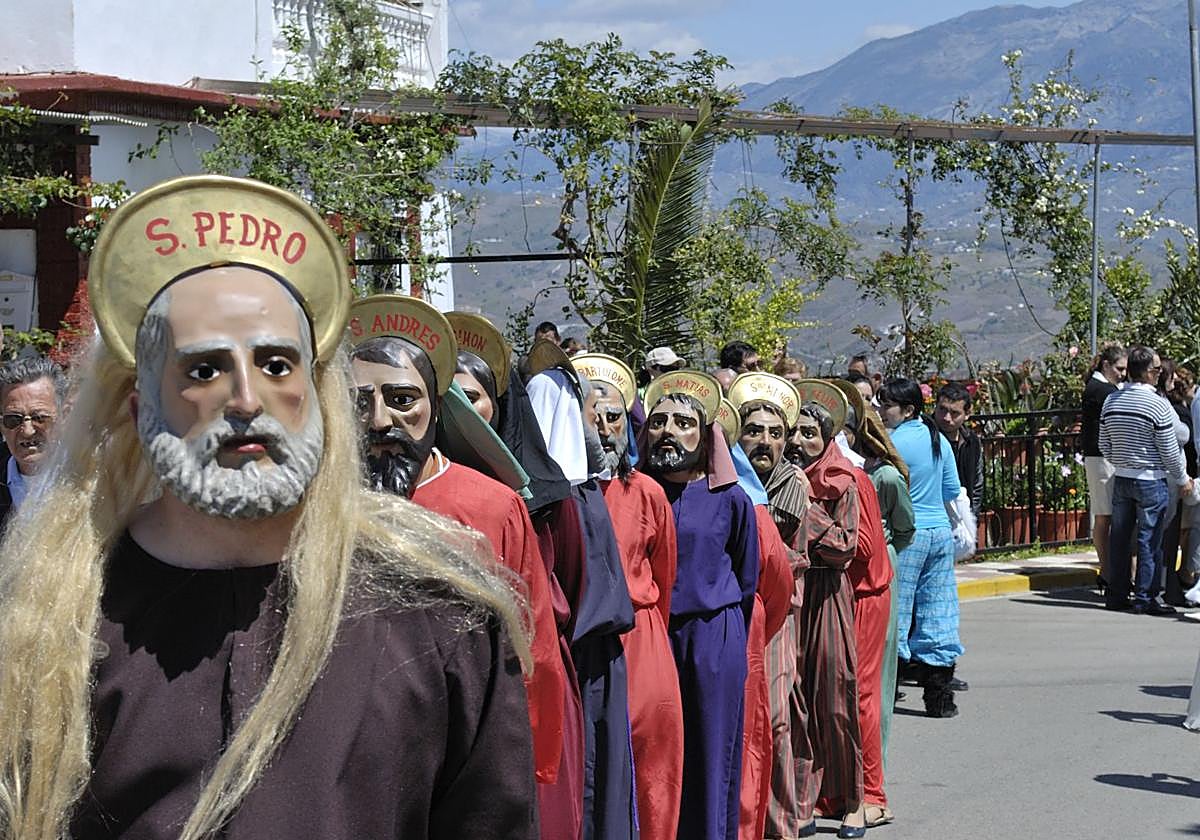
In the Axarquía, Iznate preserves one of the most unique traditions of Easter Sunday. After mass, the image of the Virgin is processed to the chapel of Santo Cristo, where a peculiar representation takes place. Several locals, dressed in tunics and ancient masks, play the apostles in a scene where they search for the image of the Child Jesus, previously hidden among plants. After the discovery, rockets are launched and a popular celebration begins that includes shared meals, in a mix of religious tradition and festive atmosphere that defines the identity of the town.
In the Heart of Moscatel, El Borge experiences the end of Holy Week in a very special way, coinciding with its patron saint festivities in honor of San Gabriel—or San 'Grabié, as it is popularly said in this town. During these days, the patron is processed along with the Virgin of the Rosary on several occasions, including Easter Sunday itself. However, beyond the religious component, the atmosphere is clearly festive, with music, community gatherings, and a relaxed tone that contrasts with the solemnity of previous days. It is a clear example of how in some towns the end of Holy Week transforms into a collective celebration.
Although many of these traditions deviate from strictly brotherhood activities, there is also room for more classic proposals with unique nuances. In Ronda, on Easter Sunday, the Virgin of Loreto is processed from the Church of the Holy Spirit, in the San Francisco neighborhood. This image is carried by women, in a tradition that dates back to the 1970s and made it one of the first thrones carried exclusively by female bearers. Along with the Risen Christ, it stars in a parade that combines solemnity and uniqueness within the Malaga brotherhood scene.

Latest news


Upcoming events
17
Sep
La Pequeña Cuba Gastro-Cultural Festival in San Pedro Alcántara 2026
18
Sep
World Wellness Weekend Marbella 2026
18
Sep
Candlelight: Queen vs. ABBA in Málaga
18
Sep
Candlelight: Coldplay and Imagine Dragons in Málaga
18
Sep
3 de Corazones – Pancho Céspedes, Enrique Ramil and José Luis Jaén in Málaga
Similar News

Málaga Airport Makes History with More Than Three Million Passengers in One Month
Málaga
Port of Málaga looks beyond its docks to support future growth
Málaga
Guide to the Virgen del Carmen Processions in Málaga and the Province
Málaga