They find a 42,000-year-old flint stone while walking on Los Álamos beach
Businesswoman Remedios Fernández Campoy picks up a small carved rock from the shore that dates back to prehistoric times.
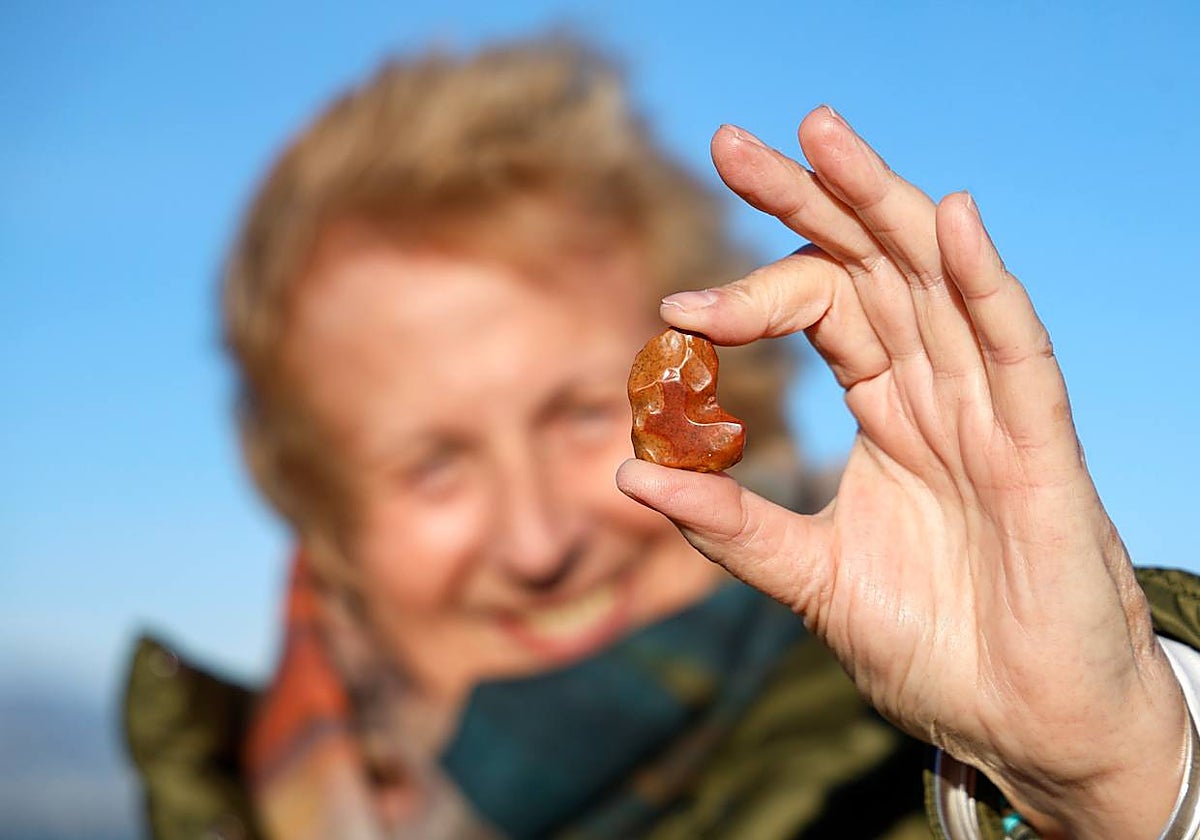

One prize from the last Christmas Lottery remained unknown. It went to Remedios Fernández Campoy, an essential figure in Torremolinos and on San Miguel street, where for decades she provided the soundtrack with her legendary Misol record store. While on December 22, the children of San Ildefonso were chanting numbers and euros, Remedios was taking a walk on Los Álamos beach as she wanted to see the snow-capped peaks of La Maroma where the first snows had fallen. But the surprise she found was at her feet, when she shifted her gaze from the horizon to the ground and noticed a stone that looked different from the rest. She bent down and hit the jackpot. Well, it was more like finding a needle in a haystack, but as if it were the first prize.
"I often come to walk along the shore because from here there's a wonderful angle of the entire bay, and although I was taking photos, I also keep my eyes glued to the ground because I love stones, and suddenly, I thought I saw a piece of flint, I picked it up and when I turned it over I said: 'But it’s carved'. I was about to freak out!" exclaims Remi, as her closest friends know her, who takes the rock out of a delicate green fabric bag to show it.
Holding the specimen in her hand, she continues explaining that at that moment she only knew that the needle in the haystack of sand she had found must be very ancient, and although part of its surface was polished by the friction over millennia in the sea like pebbles, there was no doubt that the small rock was worked and had sharp edges. "It was a unique moment," she emphasizes with a smile, recalling that the discovery left her stunned.
Fernández Campoy quickly made use of the lifeline of calling an expert and consulted with the archaeologist Pedro Cantalejo, in charge of the latest research in the caves of Rincón de la Victoria, who confirmed the nature of her 'prize' and even gave it an approximate date. "We are looking at a carved flint and, in a preliminary analysis, we could place it in the Mousterian era," details Cantalejo to SUR, after evaluating the small piece of carved stone which would be approximately 42,000 years old. He also highlights that there was prehistoric settlement in the Málaga bay linked to the beach and that, very close to the site of this fortuitous discovery, is the Bajondillo Cave site in Torremolinos.
"Here you can find shells, razor clams, pebbles, and beautifully shaped little stones, but it’s very rare to find a flint," Remedios Fernández Campoy resumes her story, who has a whole collection of rocks at home. The now-retired businesswoman, who was the last inhabitant of the Santa Clara Castle before it became a hotel, proudly shows her small flint which, from the beginning, she assumed was ancient and valuable from a heritage point of view, "but I had no idea to what extent, from the Paleolithic era." "My legs trembled when Pedro Cantalejo confirmed it," admits this explorer with a keen eye.
Precisely, the expert contextualizes this discovery since in addition to the nearby Bajondillo cave, there are several prehistoric sites from Torremolinos to Cala in the Málaga bay, so the location of this type of flint stones on the shore is within the realm of possibility. "Their appearance is not strange, but lately it is more unusual because, with the east wind storms, the beaches of Málaga have been regularly supplied with sediments that cause these types of fortuitous findings to get lost," points out Cantalejo, who recently coordinated the scientific publication 'Neanderthal Málaga. A Journey through the Origins of Málaga'.
A lover of archaeology, Remedios Fernández Campoy assures that she started this hobby with a collection of fossils, in addition to ancient stones, to which she has now added her specimen collected from the shore. "I have a publication about the Bajondillo Cave and the flints cataloged there are very similar to this one," confesses the researcher about these rocks that, when carved, created sharp edges that allowed the manufacture of cutting tools and weapons in prehistoric times. Millennia after their origin, Remi has also decided to give her stone a defensive value, but rather as a talisman. "It's on my bedside table, I often touch it and even put it under my pillow," confesses the owner of this small piece of humanity's history, who shows us her find one last time before putting it back in the soft green fabric bag. As if it were a precious stone. Or the jackpot of archaeolottery.

Latest news





Upcoming events
17
Sep
La Pequeña Cuba Gastro-Cultural Festival in San Pedro Alcántara 2026
18
Sep
World Wellness Weekend Marbella 2026
18
Sep
Candlelight: Queen vs. ABBA in Málaga
18
Sep
Candlelight: Coldplay and Imagine Dragons in Málaga
18
Sep
3 de Corazones – Pancho Céspedes, Enrique Ramil and José Luis Jaén in Málaga
Similar News

Málaga Airport Makes History with More Than Three Million Passengers in One Month
Málaga

Port of Málaga looks beyond its docks to support future growth
Málaga

Guide to the Virgen del Carmen Processions in Málaga and the Province
Málaga