A 'true crime' with a Malaga accent about the Atocha massacre
JAC López adapts in 'The Black Thread' a research on far-right terrorism that links attacks in Madrid, Lisbon, or Buenos Aires.
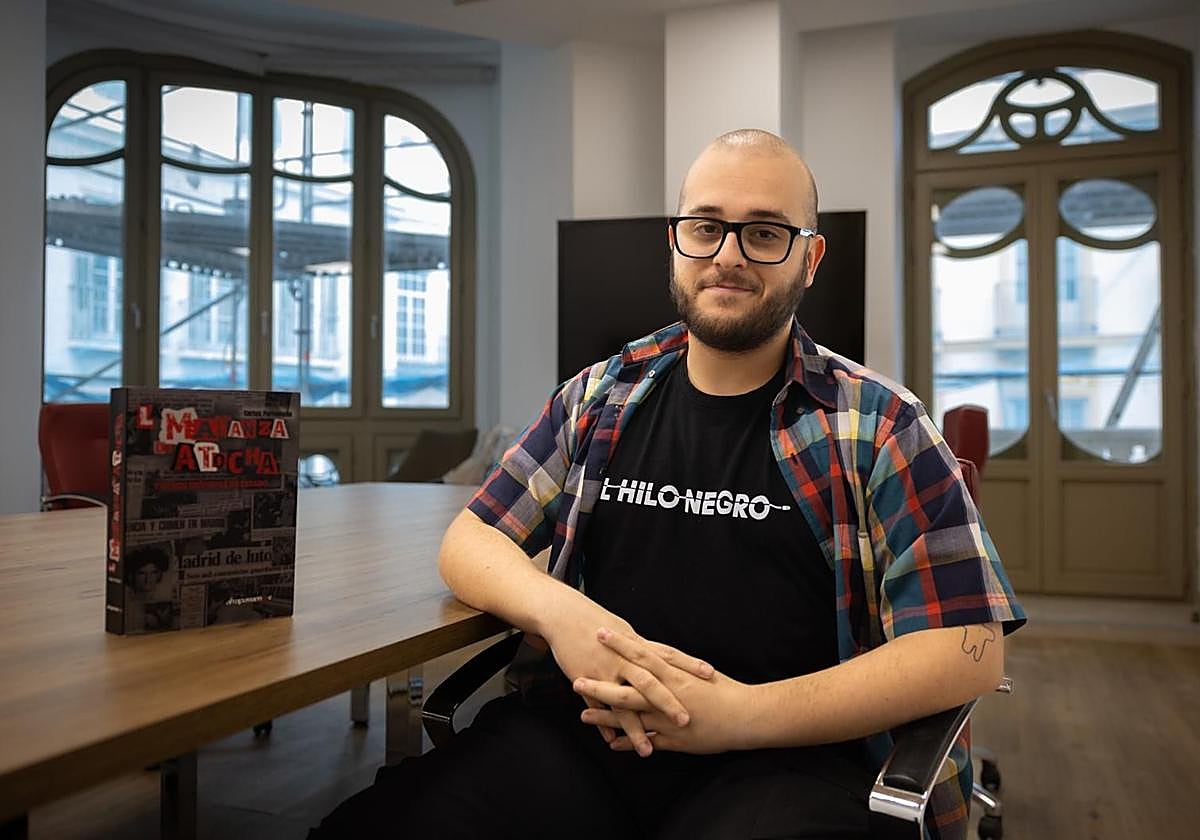

He goes by the name JAC López (José Antonio Castro López). He wanted his name to be short and to pay tribute to his mother. He is 28 years old and already has a major project in the works. But he has always been precocious: he grew up in a cultured and politicized environment and by the age of 11 or 12, he was already making short films. He recalls that he was inspired by Quentin Tarantino's 'Inglourious Basterds' for his first one, a director he admits he soon outgrew. He also early on had the ambition to move from form, from art for art's sake, to message, without neglecting aesthetics.
So, his second short film, at the age of thirteen or fourteen, was banned from being shown in class because it featured lesbian protagonists. "It was suitable for all audiences," he specifies, "but there was a couple of women." "I've always been surrounded by women, I've had many more female friends than male friends, and from a young age, I knew I belonged to the LGBTQ+ community. If I was threatened by the Nazis at my school, it was because they identified me with the far-left... with all the far-left that a child can be," he recalls, and reflects, "Things are the same now and are getting worse." He then describes the reality that bites at the youth, his people: "My generation lived a very well-intentioned lie that history progresses linearly and always for the better. We were told the lie that if you study, you have a job. My generation faces a very specific, vital uncertainty, where history seems like an endless spiral, constantly oscillating around the same things. I thought those neo-Nazis who were after me were just kids who had problems at home, who didn't have enough cultural resources. I believed that people choose culture as soon as they have access to it and that these were remnants that would disappear. It turns out that's not the case; for a certain orange man in the US, the truth means nothing."
This young man, with a narrative so solidly constructed about the problems of his generation, is not making a movie about them, but looks back to an event that occurred two decades before he was born: he is engaged in narrating an episode of History with a capital H, or a set of them at first glance independent but which, according to the writer Carlos Portomeñe and his research 'The Massacre of Atocha and other State Crimes', respond to a plot. (Here echo the reverberations of Operation Gladio, the name of the network that orchestrated attacks to destabilize democracies or aspiring democracies).
The documentary is titled 'The Black Thread', a metaphor that refers to how various events in Madrid, Rome, Lisbon—where filming has already begun and the José Saramago Foundation is involved—or Buenos Aires, are connected, as if those cities marked on the map are sewn together by tragedy and right-wing terrorism.
The epicenter of the story is Madrid, Atocha Street, a labor lawyers' office that suffered a deadly attack on January 24, 1977. A nearby place, the Marcelino Camacho auditorium, located in the basement of the national headquarters of Comisiones Obreras, which during the dictatorship housed the Vertical Syndicate, is considered as a venue for the premiere in just under a year, which will be when the half-century of the massacre is commemorated. Although JAC López also dreams of it being seen at the Malaga Festival in 2027 and of the production touring other festivals.
And another historical coincidence: Juan Antonio Bardem filmed 'Seven Days in January' about the crime in 1979. His nephew Carlos Bardem will be the narrator of the documentary by JAC López that links the violent seventies to this turbulent decade of the twenties of the 21st century. Because the project narrates history and brings it to the present. "The intention is to learn from the past, to talk about how the far-right has always existed and it’s always the same, although it mutates in its forms," he comments. "My generation, or the one coming after, lacks a bit of context about why we are where we are," he adds.
To approach his work JAC López promises "to use the enemy's weapons": "We are in the era of 'true crime' and morbid Netflix documentaries. We will try to appropriate the powerful visual level that these productions have and that attract so much attention." The idea is for the average user of platforms who would not typically watch a documentary about democratic memory to be drawn in by the use of certain editing formulas, visual style, or the way of interspersing testimonies of witnesses or victims of the attacks with dramatized and expressionist scenes recorded with actors: "It's something that aims, although it's a bit ugly to say this, to thread everything together in a way that is visceral." He insists that his ambition is to bring it to the present: "You pull and find that we are still here with the same black thread in hand."
The book by Portomeñe on which the documentary is based is a hefty volume, weighing three and a half kilos… the effort to condense it is very important. In JAC López, its author and Joaquín Recio, the film's producer, have placed their trust: "Recio was clear that he wanted a young vision, a bit foreign to what is usually the documentary about democratic memory. The idea is that it is equally educational, important, sober... but not perceived as a drag; we give it a twist so that it reaches a new audience, not just those already aware of democratic memory and antifascism." "What interests me is being able to reach that audience that can no longer stand watching a whole movie," he declares.
His experimental production 'The Loliness of Company', about the consumption of ASMR—internet content that proliferates to combat loneliness—has just been a finalist at the Notodofilmfest, and now he is waiting to premiere a fake 'stand up' also around loneliness with a text by the comedian Tito Rapha.
But for now, what is feeding him is something else. JAC López, along with his partner, the aforementioned Tito Rapha, have set up a small production company, Miel y Limón Producciones, that works for the Carnival of Malaga, for the García Caparrós Association, as well as managing the social networks of organizations and businesses. And he has also launched a board game publishing house, SideQuest.Games, taking advantage of the recent 'boom' and to contribute to that movement seeking personal connections beyond social networks, in real life. Because although he could be considered a digital native by age, in practice he is not so much: in his home there was an early awareness of screen time prevention.

Latest news



Upcoming events
17
Sep
La Pequeña Cuba Gastro-Cultural Festival in San Pedro Alcántara 2026
18
Sep
World Wellness Weekend Marbella 2026
18
Sep
Candlelight: Queen vs. ABBA in Málaga
18
Sep
Candlelight: Coldplay and Imagine Dragons in Málaga
18
Sep
3 de Corazones – Pancho Céspedes, Enrique Ramil and José Luis Jaén in Málaga
Similar News

Málaga Airport Makes History with More Than Three Million Passengers in One Month
Málaga

Port of Málaga looks beyond its docks to support future growth
Málaga

Guide to the Virgen del Carmen Processions in Málaga and the Province
Málaga