The Surprising Story of the Flores Sanctuary, in One of the Most Symbolic Sites of Álora
A hermitage built after the conquest, an image that came from Seville, and centuries of popular devotion explain the origin of the Virgin of the Flowers.
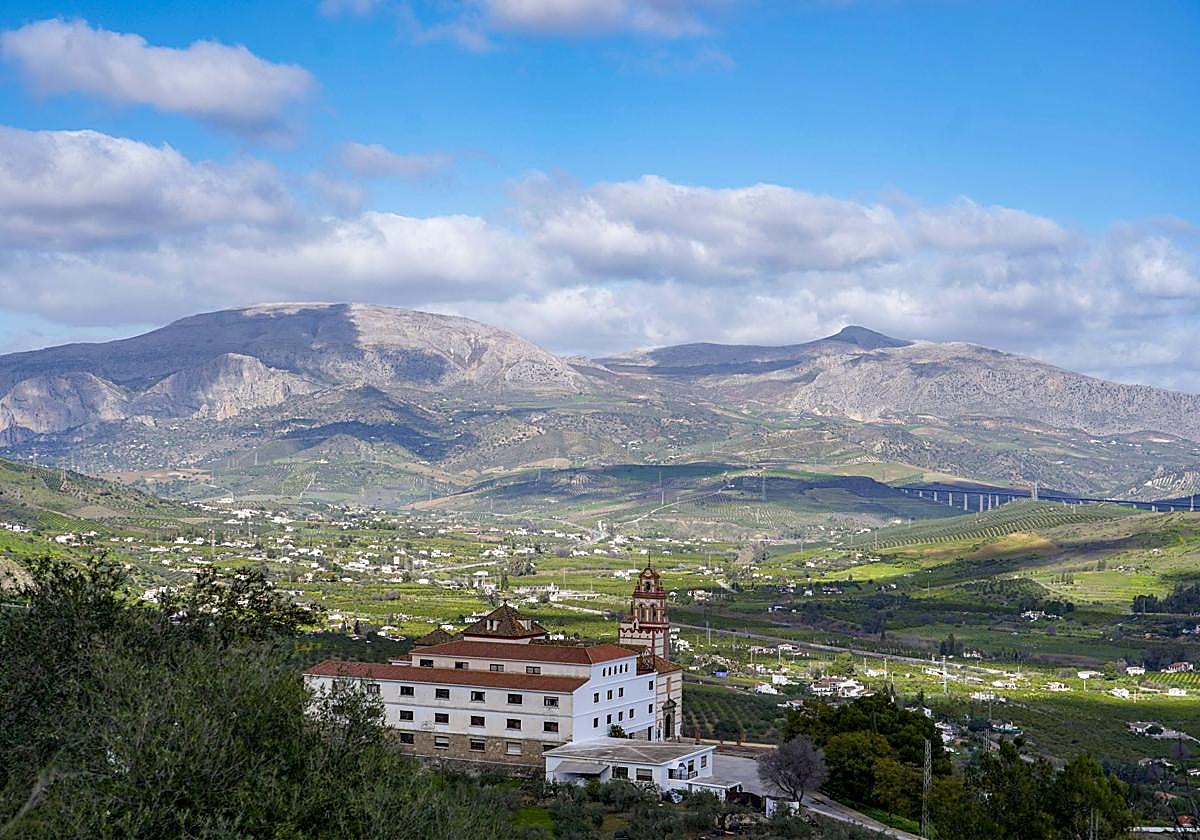

Few places in Álora hold a history as unexpected as the Sanctuary of Flores. Today, it is the heart of devotion to the Virgin of ... the Flowers and one of the most spectacular viewpoints of the Guadalhorce valley. From here, one can dominate the extensive panoramas of the agricultural landscape of the region and nearby mountain ranges such as the Hacho. But centuries ago, this same site was a military camp following the Christian conquest of the town. There, a mass was held, a hermitage was erected, and a story began that would end up turning that place into a Franciscan convent and a symbol for generations of people from Álora.
The history of the current sanctuary is deeply linked to the events that followed the Christian conquest of the area. In those times of radical change for the population, the army involved in the capture of the town set up its camp on a plain located on the outskirts of the urban center. It was precisely there where the first mass after the conquest was celebrated and even a child named Pedro de Estepa was baptized, whose mother accompanied the troops.
That episode marked the destiny of the place. By order of the queen, a small hermitage dedicated to the Virgin was to be built there, as a reminder of that foundational moment of the new Christian community. Those in charge of building it were the settlers who began to settle in the area after the conquest, many of them coming from towns like Encinasola or Cumbres Bajas.
The new hermitage needed an image for worship, and here appears one of the most curious episodes of this story. The settlers requested a Marian carving from the Crown to venerate in the temple. The chosen invocation was that of Our Lady of Flores, a denomination that already existed in Encinasola, the place of origin of some of those new inhabitants.
The site was for centuries a Franciscan convent. Below, from the surroundings of the sanctuary, one can dominate extensive panoramas of the agricultural valley of the Guadalhorce with the background of limestone mountain ranges. And the church of the convent complex retains architectural elements resulting from expansions made between the 17th and 18th centuries.According to historical studies about the site, the Catholic Monarchs commissioned the image in Seville. Once finished, the alcaide of Álora traveled to the city to collect it from the Reales Alcázares and transfer it to the town. It was the year 1502, a date that marks the birth of the devotion to the Virgin of the Flowers in the locality.
From that moment, the image became a spiritual reference for generations of residents. The small rural hermitage began to gain importance as a center of worship, until it consolidated as one of the most symbolic spaces of the territory.
More than a century later, the site would take a new step in its evolution. At the end of the 16th century, a group of residents requested the bishop of Málaga to found a Franciscan convent next to the hermitage. The request was accepted and in 1592 the establishment of the religious community was authorized, with the convent being built on land granted by the council of the town.
The presence of the friars profoundly marked the religious and social life of Álora for centuries. The complex was expanded over time and in the 18th century underwent significant architectural transformations that shaped much of its current appearance.
However, the history of the place also experienced difficult moments. In the 19th century, the disentailment forced many religious orders to leave their convents. The Franciscans had to leave Flores and the building was practically uninhabited, starting a deterioration process that threatened its continuity.
For a while, the old convent was close to disappearing, reduced to ruins amid the landscape. Despite everything, the site managed to survive thanks to the deep roots it still had among the residents of Álora and the deep bond that the population maintained with the Virgin of the Flowers.
Today, centuries after that first hermitage was erected following the conquest, the place remains one of the most special spaces for the people of Álora. Not only because of its religious significance but also because of its privileged location overlooking the Guadalhorce valley, from where some of the most extensive panoramas of the territory can be seen.
A history that has been reconstructed in detail in recent historical research, such as the doctoral thesis 'Marian Sanctuaries of the Guadalhorce Valley. Iconography, art, and popular religiosity', by María José Sánchez Rodríguez, where the origin, evolution, and cultural significance of this enclave within the religious tradition of the region are analyzed.
Because behind that white building that today overlooks the Guadalhorce landscape lies the memory of a military camp, the arrival of a Marian image linked to the Catholic Monarchs, and more than five centuries of popular devotion. A unique trajectory that explains why Flores remains one of the most beloved and symbolic places in Álora.
The uniqueness of the site has also attracted the attention of artists over time. In fact, the Prado Museum holds an oil painting titled 'The Convent of Flores' (Álora), created between 1945 and 1950 by the painter Wells Moses Sawyer. This American illustrator and photographer, who also has some of his works in the Málaga Museum, captured several landscapes and country scenes after an intense trip through different Spanish regions. In this specific case, the work captures the silhouette of the convent complex over the Guadalhorce landscape, an image that demonstrates how this place, in addition to its historical and religious importance, has been part of the artistic imagination linked to the territory.

Latest news

Upcoming events
17
Sep
La Pequeña Cuba Gastro-Cultural Festival in San Pedro Alcántara 2026
18
Sep
World Wellness Weekend Marbella 2026
18
Sep
Candlelight: Queen vs. ABBA in Málaga
18
Sep
Candlelight: Coldplay and Imagine Dragons in Málaga
18
Sep
3 de Corazones – Pancho Céspedes, Enrique Ramil and José Luis Jaén in Málaga
Similar News

Málaga Airport Makes History with More Than Three Million Passengers in One Month
Málaga
Port of Málaga looks beyond its docks to support future growth
Málaga
Guide to the Virgen del Carmen Processions in Málaga and the Province
Málaga