


Antequera, the Neolithic City
The Dolmen of Menga is not only remarkable for its size and antiquity but also for the enigmas it still poses more than 5,000 years after its construction. A Happy Encounter

If there is an enchanted place, it is undoubtedly the city of Antequera and its surroundings. The city, with its history dating back several millennia, the extraordinary and mysterious megalithic remains (a UNESCO World Heritage Site since 2016), the sacred mountains filled with myths and legends, and the incredible rock formations of the Torcal mountain range, make Antequera a magical place. A location where historical reality or imagined legend can be found in every corner, whether it's the mountains, the flat plains, or the city itself.
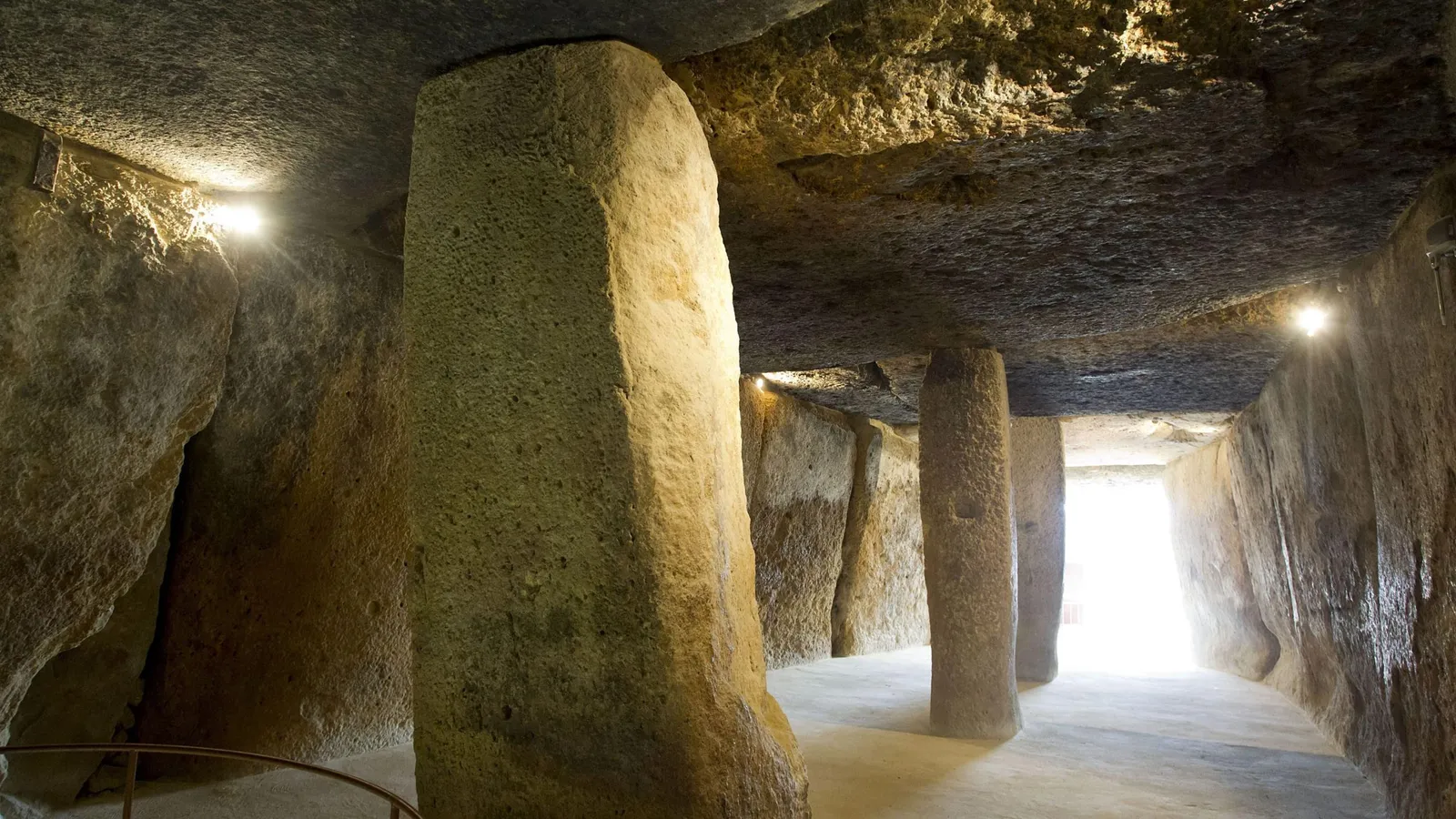
Lucio, who enjoyed telling me about Antequera and the years he lived there, began telling me about his excursions with José Manuel to the dolmens. The largest and most spectacular –he told me– is the Dolmen de Menga, one of the most impressive megalithic monuments in Europe and the jewel of the Antequera Dolmens Archaeological Site. It stands out not only for its size and antiquity but also for the enigmas it still poses more than 5,000 years after its construction. Dating from the late Neolithic period (3800 to 3600 B.C.), it belonged to an agricultural and pastoral community and was presumably a collective tomb. Its architecture is colossal. It is a covered gallery dolmen composed of huge orthostats (vertical stones) and large horizontal slabs, measuring 27.5 m long by 6 m wide and 3.5 m high. Some stones weigh more than 150 tons and it is made up of 32 large stone blocks and 3 interior pillars that support the roof. Its size makes it one of the largest dolmens in Europe.
But the most curious thing about this dolmen –Lucio continued telling me– is its orientation. Look, all the dolmens we know in Europe have their axis oriented towards the sun, be it solstices or equinoxes. The axis of the Menga gallery points directly towards the Peña de los Enamorados. This is exceptional. Archaeologists have three theories that could explain this phenomenon. One would be that they considered La Peña a sacred mountain. Its anthropomorphic silhouette could represent a deity or mythical ancestor. Another would be that they considered themselves in an integrated ritual landscape. Menga cannot be understood without the landscape. It is part of a symbolic alignment with the rock. And a third explanation would be that this Neolithic people had a different Cosmovision. Perhaps these communities placed more importance on the territory than the sky. Today it is considered one of the most advanced examples of monumental integration with the landscape in European prehistory.
But there is still another unresolved mystery in the colloquially called “Cueva de Menga”: the well. This is indeed the great enigma. Inside the dolmen, there is a well dug into the rock, 19 meters deep. This feature is unique in European megalithic monuments and its function is not known for certain, whether it had something to do with water, a symbolic connection with the underworld, or if the well was made in later times. The mystery remains open.
What is certain is that it had a funerary use, as human remains corresponding to collective burials have been found. It was used over generations and possibly belonged to an elite or prominent lineage. Although the construction also has its mystery. It is difficult to explain how they could move stones of more than 100 tons without wheels and without metals. Menga demonstrates that these communities were much more sophisticated than was thought for centuries.
But Menga is not isolated; it is part of a megalithic complex along with the Dolmen de Viera and the Tholos de El Romeral, which in turn are part of a monumental landscape with La Peña de los Enamorados and El Torcal de Antequera. This ensemble creates a unique relationship between architecture, nature, and symbolism.
All of the Antequera megalithism, Lucio was eager to tell me without even asking for a beer. We were at the “Chipirón colorao” and Rafael, the old fisherman, was getting annoyed because we were occupying a small table without ordering anything. So I interrupted him and asked: What do you want, Lucio? The usual –he answered–. Rafael brought us two wines and some olives. Lucio had already started his story again.
A few meters from the Dolmen de Menga, stands a silent and precise construction that has withstood five millennia: the Dolmen de Viera. It was discovered in 1903 by the Viera brothers. This megalithic monument is one of the best examples of Neolithic funerary architecture on the Iberian Peninsula.
Unlike Menga, Viera is clearly oriented towards the east. Every equinox, the first rays of dawn penetrate through its narrow corridor to illuminate the funerary chamber, a phenomenon that reveals the advanced astronomical knowledge of the communities that built it around 3500–3000 B.C.
The monument, about 21 meters long, is formed by large vertical orthostats and horizontal slabs covering a long and narrow passageway leading to a square chamber. Collective burials were conducted there, probably linked to a specific lineage or social group. Today, integrated into the Antequera Dolmens complex, the Dolmen de Viera continues to offer a powerful image: that of a prehistoric society capable of erecting enduring monuments and aligning them with the exact light of the sky.
In the plains of Antequera, where the landscape opens up to almost unreal rock formations, stands one of the most unique monuments of European prehistory: the Tholos de El Romeral. Built around 2500 B.C., this collective tomb marks a radical evolution from the large neighboring dolmens.
Unlike the nearby Dolmen de Menga or the Dolmen de Viera, built with huge vertical blocks and horizontal slabs, El Romeral opts for a different technique: the false dome. Its main funerary chamber is covered by approximated courses, a construction system that creates a sealed vault without the need for a large cover stone.
Access is through a long corridor leading to a circular chamber and, further back, to a second smaller room. The structure, built with smaller stones carefully arranged, demonstrates sophisticated architectural knowledge and a clear transformation in the funerary practices of the time.
Another surprising detail is its orientation: the axis of the monument does not point to the sun, but towards the karst landscape of El Torcal de Antequera, again integrating architecture and landscape in a symbolic relationship that characterizes the Antequera ensemble.
As I told you, Juan, it was declared a World Heritage Site by UNESCO in 2016 along with the other great megaliths of the city. The Tholos de El Romeral confirms that more than four thousand years ago, the communities that inhabited this land not only buried their dead: they raised monuments designed to engage with the territory and endure beyond their time.
This is the most important megalithic complex on the Iberian Peninsula, one of the most important and impressive in Europe, and a magical place that no one should miss, especially after being declared a World Heritage Site by UNESCO in 2016, a feat largely due to the efforts of its director until recently, the archaeologist and friend, Bartolomé Ruiz González.

Latest news





Upcoming events
12
Nov
El Desembarco, la traición de Viriato at La Caja Blanca
12
Nov
HOMER El Mero Mero at Sala Trinchera Málaga
13
Nov
Marbella Startup Lab – Innovate & Collaborate
13
Nov
Candlelight: Coldplay & Imagine Dragons at Sala Fundación Unicaja María Cristina
13
Nov
Candlelight: Tribute to Ludovico Einaudi at Anantara Villa Padierna
Similar News

Agriculture generates 300 million euros in the Antequera region
Antequera


The new Leroy Merlin logistics center in Antequera begins operations
Antequera
