Mijas will take over 96 housing developments to ensure the
The City Council initiates the processing of a municipal ordinance to take over these residential areas and ensure the provision of services. Residents denounce the lack of lighting in various parts of the Riviera development in Mijas.
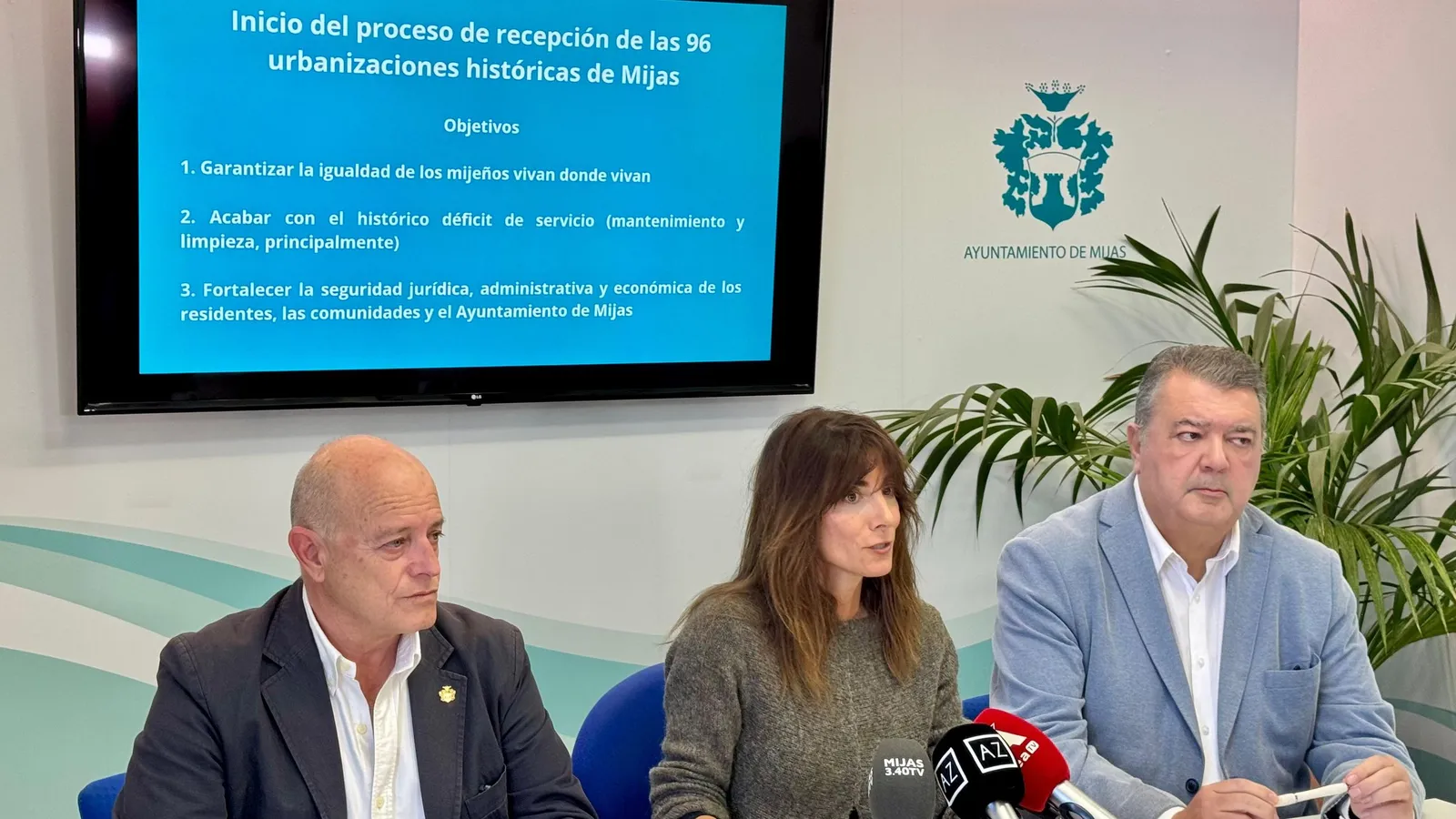

The City Council of Mijas officially started the process this Monday to pass an ordinance for the reception of the 96 historic urbanizations within the municipal area, a measure that will guarantee "equality" in service provision for all residents of Mijas, as announced by the mayor, Ana Mata.
The mayor disclosed this information, accompanied by the Councilor for Urbanizations, Juan Carlos Cuevas, and the Councilor for Economy and Finance, Mario Bravo, emphasizing that the decision addresses a "demand" from the citizens that has persisted for decades, as these 96 urbanizations have never been officially accepted by the City Council, despite being classified as “consolidated urban land.”
The future municipal ordinance regulating the reception of historic urbanizations will be governed by the mechanisms provided in the Law for the Promotion of Sustainability of the Territory of Andalusia (LISTA) and aims to remedy a "disadvantage" suffered by these residential areas, due to the "lack of clarity on who should maintain and uphold roads, sanitation networks, water supply, lighting, or green areas," the City Council stated in a press release.
This situation has historically created "tax inequality and prolonged disparities in service provision," as residents of these urbanizations pay the same taxes as those in urban centers, the statement further detailed regarding the payment of the Property Tax (IBI).
According to the City Council, homeowners' associations have often been unable to bear the costs derived from the aforementioned maintenance, leading to unfavorable conditions in health, environmental, and road safety aspects. This has resulted in a "progressive lack of basic urban service provision and a decline in the quality of these services," also preventing access to grants and aids for improving services and infrastructure.
Mata explained that this scenario could lead to "environmental and road safety risk situations," as well as a "progressive lack of basic urban service provision and a decrease in the quality of these services." Thus, she emphasized that this "historic decision" will end the "legal, administrative, and economic insecurity."
Furthermore, she stated that equality in services "is a right of the citizens, and therefore, it is an obligation for this municipal government team," stressing that this issue has not been addressed in half a century.
Processing of the ordinance
Specifically, the ordinance process begins with the mandatory public consultation, published this Monday on the City Council's website and will be available for 15 business days until February 16, thereby complying with article 133.1 of the Law 39/2015, of October 1, on the Common Administrative Procedure of Public Administrations.
The City Council noted that this ordinance will serve to identify the problems to be solved, the necessity and timeliness of its approval, and the possible alternative regulatory and non-regulatory solutions.
The new regulation also aims to gather the opinions of citizens and organizations potentially affected by the future ordinance, thus enhancing public participation.
The head of Economy and Finance, Mario Bravo, clarified that the consultation starting today is independent from the hearing and public information process that will later open, as required by law, in the ordinance proceedings.
In this regard, he added that the government team of Mijas embraces the principle of equal rights for equal obligations: "We believe that a street open to the public should be maintained with public funds, including cleaning, lighting, and paving. We cannot make distinctions between citizens who are not different."
Legal security
Meanwhile, the Councilor for Urbanizations argued that the future regulation will provide "legal security" to both residents and the City Council and "will establish a clear and participative procedure to guarantee the rights of residents and the fulfillment of public obligations in terms of essential services."
Cuevas emphasized that "with this ordinance, we aim to move from temporary fixes to a structured and definitive solution," and highlighted that "the City Council will set the framework and support the urbanizations throughout the process, because this can only be resolved by working together and listening to those who live there."

Latest news




Upcoming events
17
Sep
La Pequeña Cuba Gastro-Cultural Festival in San Pedro Alcántara 2026
18
Sep
World Wellness Weekend Marbella 2026
18
Sep
Candlelight: Queen vs. ABBA in Málaga
18
Sep
Candlelight: Coldplay and Imagine Dragons in Málaga
18
Sep
3 de Corazones – Pancho Céspedes, Enrique Ramil and José Luis Jaén in Málaga
Similar News

A survival camp in Mijas teaches children how to make fire and build shelters
Mijas

Sarao Nights Returns to La Zambra Resort with a Launch Party Headlined by Daisy Dee
Mijas
Mijas will celebrate a jazz night to benefit the Food Bank
Mijas