


Lucio Discovers Antequera
In the sixties, Spain was backward, but this city was almost in the Middle Ages. The year of long pants.
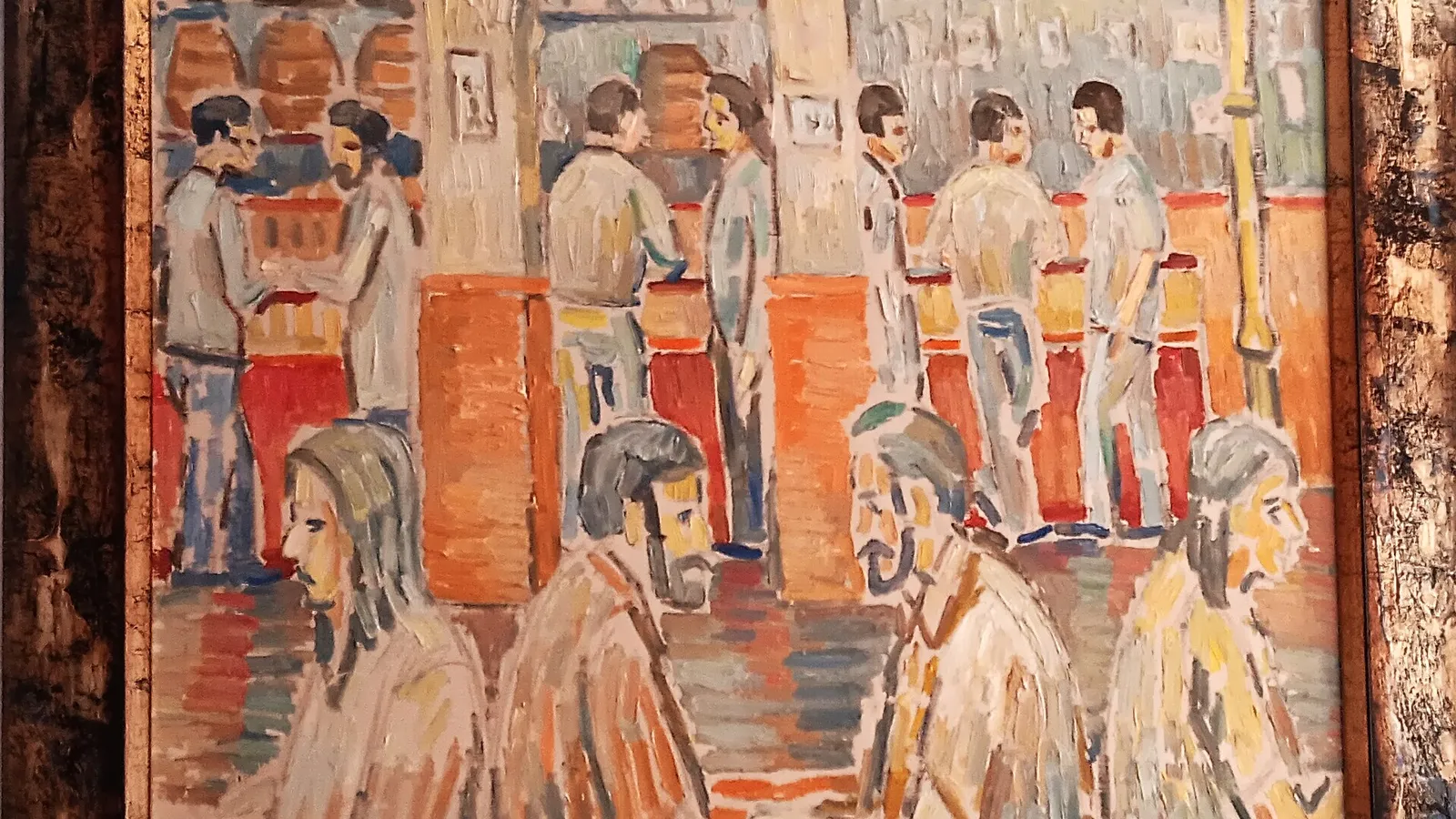

That day, we did not go to “Chipirón colorao” in El Palo, where Lucio and I usually met. Instead, we had agreed to have some wines at La Buena Sombra, right in the center of Málaga, specifically at number 10 Sánchez Pastor street. A tavern with a tavern keeper who had made it a kind of temple for students, artists, intellectuals, and rebellious progressives. This was a few years before the establishment permanently closed in 1981. I reminded Lucio of an exhibition, held in the early 60s, by the excellent painter and caricaturist George Campbell. An Irishman who settled in Málaga and was a regular at La Buena Sombra. Almost twenty years later, a fantastic oil painting showing the tavern and its hippie atmosphere came into my collection. It was signed in 1979 by Cabrolie, an extraordinary French painter who shone in the post-war Parisian bohemia. I confess that I had been after that painting ever since I saw it, because it is a gem, both artistically and emotionally.
Reminding Lucio of that gave him the opportunity to tell me new episodes of his dreamt or not reality. Sometimes Lucio would repeat himself and tell me the same stories multiple times, but they were like new versions of the same song, and I listened to him pleasantly. The year 1960, he said, was a crucial year from every point of view. In the global political landscape, we must not forget the profound changes that occurred, including the decolonization of half of Africa, the Cold War reaching its highest tension when the Soviets decided to shoot down an American plane, and the Americans, understandably, got angry. To top it off, Fidel Castro, who had taken power in Cuba in '59, nationalized all American businesses, something the Yankees didn't appreciate much. It was the year J.F. Kennedy became president of the USA. Everything in the world revolved around the relations between Americans and Soviets. Europe was recovering from World War II, and in Spain, the stabilization plans began, which led to strong economic, industrial, and urban expansion. Consumption grew, and a lot of foreign currency came from remittances from emigrants and tourism.
By then, Lucio continued, I was at an age where I began to take an interest in political issues. But above all, I was interested in the tourism boom in Málaga and its Costa del Sol. It meant a breath of fresh air, more freedom (except politically) and the illusion, seldom materialized, of hooking up with Swedish girls in Torremolinos. In this matter, boasting was far from reality. But, despite the dictatorship, Málaga was one of the culturally most open areas in Spain, thanks to contact with foreigners.
From my neighborhood gang, Julián was the wealthiest, economically speaking, because he worked as a bartender at the Escandinava hotel bar in Torremolinos. He, who was a music lover of modern music and had a huge collection of vinyl records, kept us up to date with the musical scene in the world and, logically, in Spain. Rock and roll was his passion, and his collection included the latest market releases from Elvis Presley, still in the forefront, Chuck Berry, Little Berry, or Buddy Holly; nor were there missing albums from melodic singers like Frank Sinatra or Paul Anka and, of course, Spanish groups like Dúo Dinámico, Los Mustang, or Los Brincos.
My usual gang was made up of six close comrades, namely: Julián, Juan Ángel, Joaquín, José Manuel, Juani, and myself, of course. I remember, Lucio continued, that Juani fell in love with a very pretty blonde girl who worked as a waitress in a bar on Arango street, very close to our neighborhood, and we all went there to have drinks while Juani spent a fortune playing coins in the jukebox, which ended up being a bit annoying because he would only play the same two songs: “Lolita” by Dúo Dinámico and the other one, by Los Bravos, whose lyrics went something like: “at sunset, you're like to stop a train, at sunset,” and every time the sun set, Lolita would serve us another drink, which cost us quite a few pennies. Besides that, we organized parties at Julián's house, and at one of them, I danced with a girl, Maruchi, who became the first platonic love of my life.
In June of that year, I finished the fourth course of elementary baccalaureate at the Colegio del Sagrado Corazón de Jesús and passed the corresponding exam, which was held at the Escuela de Comercio in Martiricos. My father's contract with the government of Morocco ended, and he was assigned a teaching position in Antequera. But (what a coincidence) they notified him of the position in mid-November, so I had to start my fifth year of higher baccalaureate again, losing the first trimester, although they were kind enough to enroll me. Thus, this new year became a year of new destiny, which would significantly influence my life.
I don't want to overlook the fact that, before moving to live in Antequera, in the Congregation of Don Ernesto Wilson, I had quite a few contacts with the sculptor Paco Sánchez Ramos who, apart from working on religious imagery, was in a workshop where they made floor lamps with wood carvings, like an Indian or a horse's head, etc. He took me to see the workshop once, and he was somewhat upset because they had bought a machine in Germany that, from a plaster sculpture he made, reproduced eight carvings in wood at the same time. I'm telling you this, Juan, because it so happened that, already living in Antequera, I ran into such an extraordinary friend again.
And the day came. After the Christmas festivities, we moved into our new house in Antequera. It was in a block of apartments for teachers next to the El Maulí football field. And I started my classes at the Instituto Pedro Espinosa. I was surprised, upon entering the classroom, that all the walls had display cases exhibiting all kinds of medium or small-sized Iberian animals, stuffed. I was also surprised by the laboratory, so old that it could have belonged to Faraday or Gay Lussac.
Antequera seemed to me a stately city, and it is, although by its appearance and its people one might say that time had stopped there. In the sixties, Spain was backward, but Antequera was almost in the Middle Ages. I say this because one of the things that surprised me, as I got to know my classmates and their families, was that in every house (some, real palaces) I entered, they asked me: And you, what family are you from? Over time, I always opted to answer: From the Sánchez family. And let them find out.
Over time, I realized the social composition of the city. It was composed of four strata based on their socioeconomic position, power, occupation, and lifestyle. The upper class, aristocratic and wealthy, whose children did not study in Antequera, the impoverished aristocracy, the bourgeoisie, and the middle class, whose children studied at the institute or in religious schools in the city, and the working class, whose children did not study.
Another peculiarity of Antequera is the enormous amount of churches and convents it has. Comparable, undoubtedly, to the satanic and cassocked Orihuela. And, although it was never an episcopal see, it had the Royal Collegiate Church of Santa María la Mayor that performed the functions of a cathedral, with a chapter and great importance. Be that as it may, Antequera was for me a dreamt reality.

Latest news





Upcoming events
12
Nov
El Desembarco, la traición de Viriato at La Caja Blanca
12
Nov
HOMER El Mero Mero at Sala Trinchera Málaga
13
Nov
Marbella Startup Lab – Innovate & Collaborate
13
Nov
Candlelight: Coldplay & Imagine Dragons at Sala Fundación Unicaja María Cristina
13
Nov
Candlelight: Tribute to Ludovico Einaudi at Anantara Villa Padierna
Similar News

Agriculture generates 300 million euros in the Antequera region
Antequera

The new Leroy Merlin logistics center in Antequera begins operations
Antequera
