The story of Málaga’s Virgen de la Victoria: the dream of Ferdinand the Catholic that became a 500-year-old tradition
Tradition traces devotion to Málaga’s patron saint back to the siege of 1487, when Ferdinand the Catholic is said to have dreamed of an image of the Virgin just days before the city was conquered.
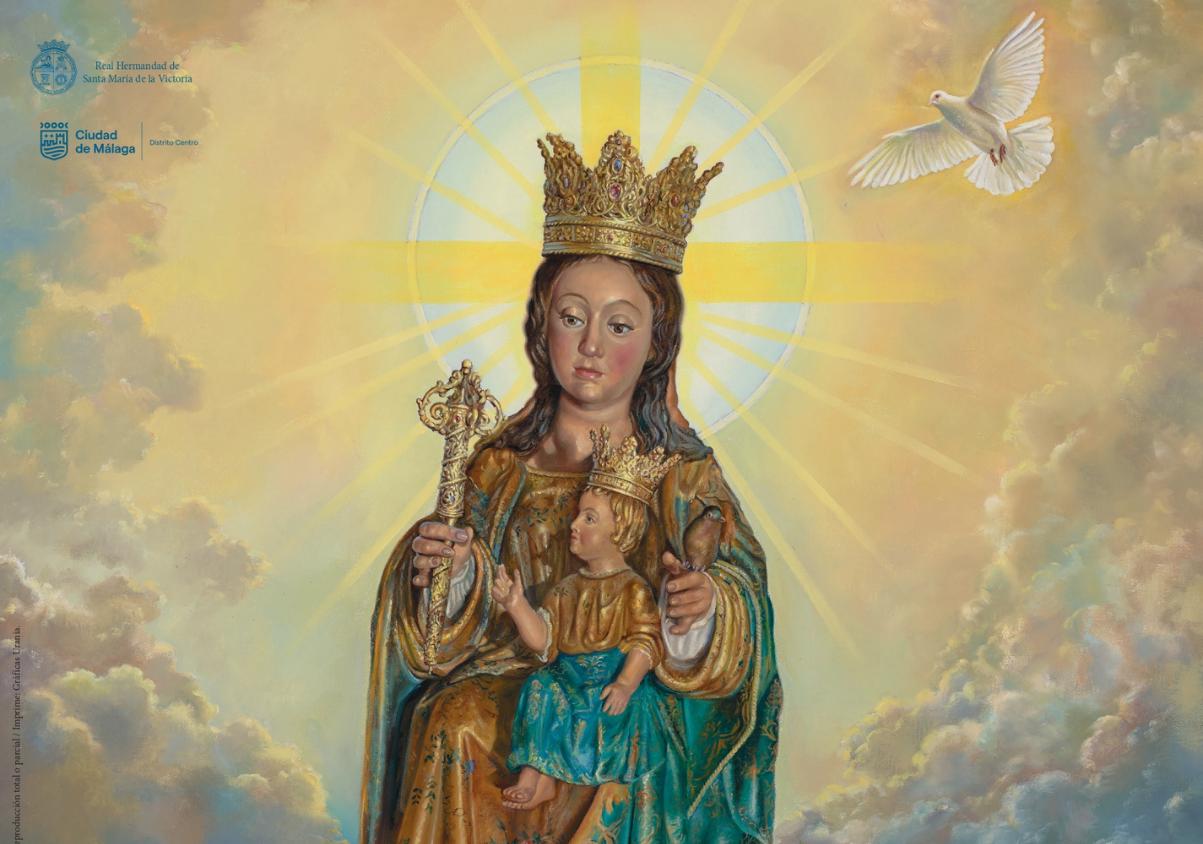

Every 8 September, Málaga celebrates the feast of Santa María de la Victoria, patron saint of the city and its Diocese. Behind the annual celebration lies a story that combines documented history with a tradition passed down for more than five centuries.
Its origins take us back to 1487, when the forces of the Catholic Monarchs were laying siege to Muslim Málaga.
Málaga, a key stronghold for the Catholic Monarchs
The conquest of Málaga was one of the toughest campaigns of the Granada War.
Its port and proximity to North Africa made the city strategically important to the Nasrid Kingdom of Granada, which could receive reinforcements and supplies through the coast.
The siege began in May 1487 and lasted for several months. During this period, Ferdinand the Catholic established his military camp on the site where the Basilica and Royal Sanctuary of Santa María de la Victoria stands today.
According to tradition, the king kept a small polychrome wooden image of the Virgin there.
Ferdinand the Catholic’s dream
The most legendary part of the story begins during those difficult months.
Tradition says that Ferdinand dreamed of the Virgin accompanied by an elderly man who interceded before her for the victory of the Christian army.
Soon afterwards, several friars from the Order of Minims arrived at the royal camp. They had been sent by Saint Francis of Paola.
The friars brought a message asking the king not to abandon the siege because, according to tradition, victory would come within three days.
Ferdinand is then said to have recognised Saint Francis of Paola as the elderly man who had appeared in his dream.
The conquest of Málaga and the name “Victoria”
Málaga eventually surrendered in August 1487 after months of resistance.
Tradition interpreted the outcome as confirmation of the prediction and of the Virgin’s protection. From that moment, the image became increasingly known under the title Santa María de la Victoria – Our Lady of Victory.
The place where the royal camp had stood remained permanently linked to this devotion.
The Catholic Monarchs later supported the presence of the Minim friars in the area, where a religious complex gradually developed and eventually became the sanctuary seen today.
Was the Virgin a gift from Maximilian of Austria?
One of the best-known traditions claims that the image was a gift from Maximilian I of Habsburg to the Catholic Monarchs.
However, this belongs mainly to the traditional account surrounding the image.
The exact authorship of the sculpture remains unknown, and several theories have been proposed over the centuries concerning both its origin and its maker.
It is therefore important to distinguish between documented historical facts and the legendary elements that have accompanied devotion to the Virgin for generations.
From a royal military camp to the Basilica of La Victoria
After the conquest, devotion to the Virgin became established at the site where Ferdinand had set up his camp.
The present Basilica and Royal Sanctuary of Santa María de la Victoria is a later building, inaugurated in 1700, although it preserves the historic connection with the events of 1487.
Over time, the image became one of Málaga’s most important religious symbols.
On 12 December 1867, Pope Pius IX officially declared Santa María de la Victoria the Principal Patron Saint of Málaga and its Diocese.
The image was later canonically crowned in 1943.
Why is the Virgen de la Victoria celebrated on 8 September?
8 September coincides with the Catholic feast of the Nativity of the Virgin Mary and is also the date on which Málaga officially honours its patron saint.
It is now a local public holiday in Málaga city.
Each year, the image is taken to Málaga Cathedral for a series of religious services before returning in procession to its Sanctuary.
More than five centuries later, the story remains deeply rooted in the city’s identity.
Ferdinand’s dream, the friars sent by Saint Francis of Paola and the prediction of victory within three days all form part of a tradition built around real historical events — and help explain how a small 15th-century image became one of Málaga’s most enduring symbols.
The history of the Sanctuary, its connection with Ferdinand the Catholic’s camp in 1487 and the tradition surrounding the origin of the image can be found in the official information published by the Diocese of Málaga on the Basilica and Royal Sanctuary of Santa María de la Victoria.

Latest news

Upcoming events
17
Sep
La Pequeña Cuba Gastro-Cultural Festival in San Pedro Alcántara 2026
18
Sep
World Wellness Weekend Marbella 2026
18
Sep
Candlelight: Queen vs. ABBA in Málaga
18
Sep
Candlelight: Coldplay and Imagine Dragons in Málaga
18
Sep
3 de Corazones – Pancho Céspedes, Enrique Ramil and José Luis Jaén in Málaga